


William Herschel
Released Album
Symphony
-
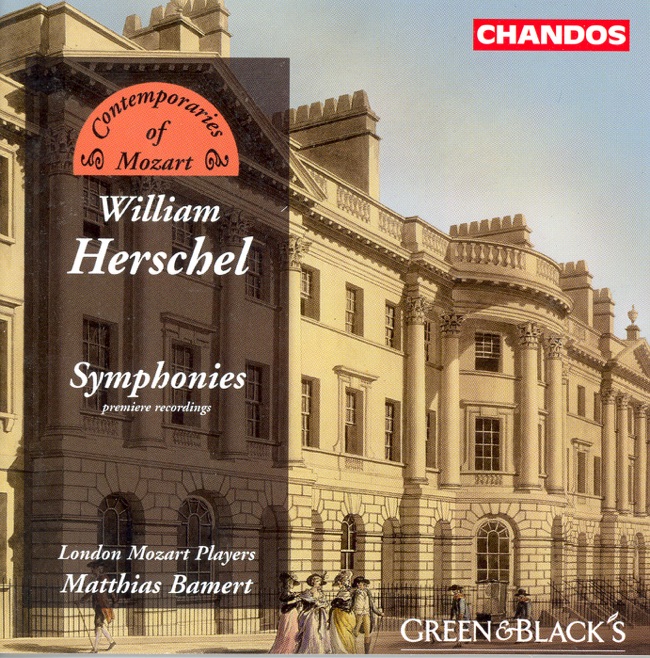 April 22, 2003
Concerto
-
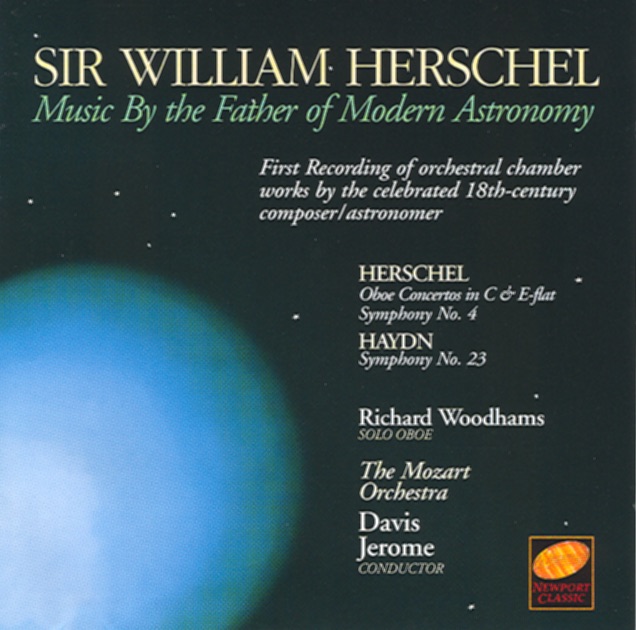 October 24, 1995
Artist Info
Role:ComposerBirth:1738Death:1822Period:ClassicalGenre:ConcertoSymphonyWilliam Herschel was a German-born British astronomer and composer who lived from 1738 to 1822. He is best known for his contributions to astronomy, including the discovery of the planet Uranus, but he was also a talented musician who composed over 200 works during his lifetime. Herschel was born in Hanover, Germany, on November 15, 1738. His father, Isaac Herschel, was a musician who played the oboe and the violin, and William and his siblings were all trained in music from a young age. William showed a particular talent for the oboe and the organ, and he began performing in public concerts when he was just 14 years old. In 1757, Herschel moved to England to join his brother Jacob, who was already living there and working as a musician. William quickly established himself as a successful performer and composer, and he became a member of the prestigious Bath Orchestra in 1766. He also began to experiment with new musical forms and techniques, including writing symphonies and concertos that featured the newly-invented clarinet. Despite his success as a musician, Herschel was also deeply interested in astronomy. He began studying the stars and planets in his spare time, and he built his own telescopes to observe the night sky. In 1781, he made a groundbreaking discovery: a new planet that he named Uranus. This discovery brought Herschel international fame and recognition, and he was soon appointed as the King's Astronomer by King George III. Despite his new role as an astronomer, Herschel continued to compose music throughout his life. He wrote over 200 works in a variety of genres, including symphonies, concertos, chamber music, and vocal music. His music was influenced by the classical style of his time, but he also incorporated elements of the Baroque and Romantic periods. One of Herschel's most famous works is his Symphony No. 8 in C minor, which he composed in 1779. This symphony is notable for its use of the clarinet, which Herschel had recently introduced to the orchestra. The piece is also notable for its dramatic and emotional themes, which were unusual for the time. Herschel also wrote a number of concertos for various instruments, including the oboe, the violin, and the cello. His Oboe Concerto in C major is particularly well-known, and it is still performed today by oboists around the world. The piece is notable for its virtuosic solo passages and its lively, dance-like rhythms. In addition to his instrumental music, Herschel also wrote a number of vocal works, including cantatas, oratorios, and songs. His oratorio The Triumph of Time and Truth is one of his most famous vocal works, and it was performed at the Royal Opera House in London in 1795. The piece is notable for its grand choral passages and its powerful solo arias. Despite his success as a composer, Herschel is best known for his contributions to astronomy. He continued to study the stars and planets throughout his life, and he made a number of important discoveries, including the moons of Uranus and the rings of Saturn. He was also a pioneer in the field of infrared astronomy, and he discovered a number of new nebulae and star clusters using his telescopes. Herschel died on August 25, 1822, at the age of 83. He left behind a legacy as both a musician and a scientist, and his contributions to both fields continue to be celebrated today.More....
Recent Artist Music
Copyright Ⓒ 2013 Davinci Finger. All rights reseved
Service Terms & Policy