


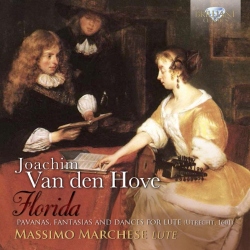
Joachim Van den Hove
Released Album
Chamber
-
 April 17, 2019
 -
-
Miscellaneous
-
 November 21, 1995
Artist Info
Role:ComposerBirth:1567Death:1620Period:BaroqueGenre:OrchestralJoachim Van den Hove was a Flemish composer and lutenist who lived during the late Renaissance and early Baroque periods. He was born in Antwerp, Belgium in 1567, and little is known about his early life and musical training. However, it is believed that he received his education in Antwerp and may have studied with some of the leading musicians of the time. Van den Hove's career as a musician began in the late 16th century when he became a lutenist at the court of the Archduke Albert and the Infanta Isabella in Brussels. He quickly gained a reputation as one of the finest lutenists of his time and was highly regarded by his contemporaries. In addition to his work at the court, Van den Hove also performed in public concerts and composed music for the lute. Van den Hove's music is characterized by its virtuosity and complexity, and he was known for his skillful use of counterpoint and his ability to create intricate and elaborate musical structures. His compositions for the lute are particularly noteworthy, and he is considered one of the most important lute composers of the late Renaissance and early Baroque periods. One of Van den Hove's most famous works is his collection of lute pieces entitled "Secretum Musarum," which was published in 1601. This collection contains 42 pieces for solo lute, and it is considered one of the most important collections of lute music from the early Baroque period. The pieces in "Secretum Musarum" are highly virtuosic and demonstrate Van den Hove's mastery of the lute. Another notable work by Van den Hove is his collection of lute duets entitled "Delitiae Musicae," which was published in 1612. This collection contains 24 duets for two lutes, and it is considered one of the most important collections of lute duets from the early Baroque period. The duets in "Delitiae Musicae" are highly complex and demonstrate Van den Hove's skillful use of counterpoint. In addition to his work as a composer, Van den Hove was also a respected music theorist and wrote several treatises on music. His most famous treatise is entitled "Apologia Musices," which was published in 1605. This treatise defends the use of music in the church and argues that music is an essential part of religious worship. Van den Hove's career as a musician and composer was cut short by his untimely death in 1620. However, his legacy as one of the most important lutenists and composers of the late Renaissance and early Baroque periods lives on through his music and his influence on later generations of musicians.More....
Recent Artist Music
9

Courante Mr lacques Pollonois in D minor (from "Delitiæ Musicæ," f.62r)
Courante, from Delitiae Musicae
1:22
10
4:42
Copyright Ⓒ 2013 Davinci Finger. All rights reseved
Service Terms & Policy