


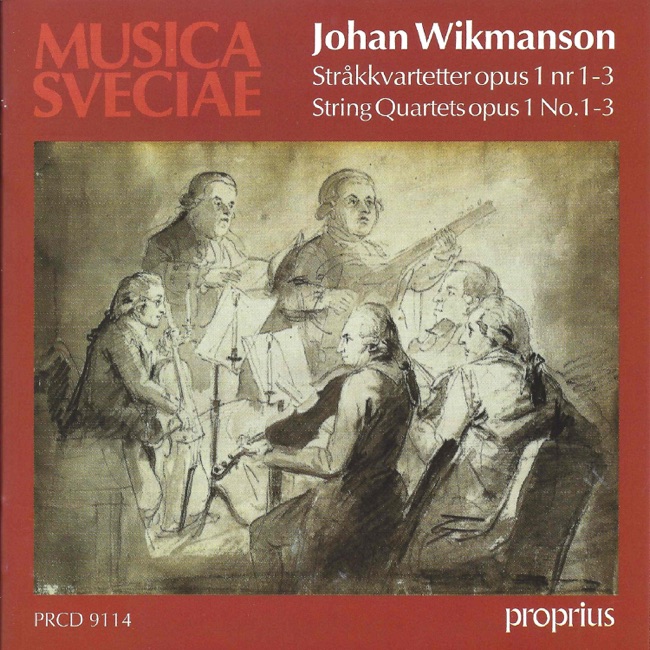
Johan Wikmanson
Released Album
Chamber

Keyboard
-
 July 25, 2006
Artist Info
Role:ComposerCountry: SwedenBirth:December 28, 1753Death:January 10, 1800Period:ClassicalGenre:ChamberJohan Wikmanson was a Swedish composer who lived from 1753 to 1800. He was born in Stockholm, Sweden, and grew up in a family of musicians. His father, Johan Wikmanson Sr., was a well-known composer and organist, and his mother, Maria Elisabeth, was a singer. Johan Jr. showed an early interest in music and began studying the violin and keyboard at a young age. Wikmanson's musical education continued at the Royal Swedish Academy of Music, where he studied composition with Johan Helmich Roman, the "father of Swedish music." Roman was a major influence on Wikmanson's style, which was characterized by a blend of Swedish folk music and classical forms. Wikmanson's early works were mostly instrumental pieces, including sonatas for violin and keyboard, string quartets, and symphonies. He also wrote a number of vocal works, including cantatas and songs. One of his most famous works from this period is his Symphony in C Major, which was premiered in 1778 and received critical acclaim. In 1780, Wikmanson was appointed court composer to King Gustav III of Sweden. This position gave him access to the royal court and allowed him to compose music for state occasions and royal events. He also continued to write instrumental and vocal works, including his opera "Thetis and Peleus," which was premiered in 1784. Wikmanson's music was well-received during his lifetime, and he was considered one of the leading composers in Sweden. His style was characterized by a blend of Swedish folk music and classical forms, and he was known for his use of simple, memorable melodies and clear, transparent textures. Despite his success, Wikmanson's life was not without its challenges. He suffered from poor health throughout his life, and his financial situation was often precarious. He also faced criticism from some quarters for his use of Swedish folk music in his compositions, which some felt was not appropriate for classical music. Despite these challenges, Wikmanson continued to compose throughout his life. His later works include a number of vocal pieces, including his "Swedish Hymnbook," which was published in 1790 and contained a collection of hymns set to music. He also wrote a number of instrumental works, including his Symphony in D Major, which was premiered in 1798. Wikmanson died in Stockholm in 1800 at the age of 47. Despite his relatively short life, he left behind a significant body of work that continues to be performed and appreciated today. His music is known for its blend of Swedish folk music and classical forms, and his use of simple, memorable melodies and clear, transparent textures. He is considered one of the leading composers of the Swedish classical tradition, and his legacy continues to inspire musicians and audiences around the world.More....
Recent Artist Music
1
5:27

Copyright Ⓒ 2013 Davinci Finger. All rights reseved
Service Terms & Policy