


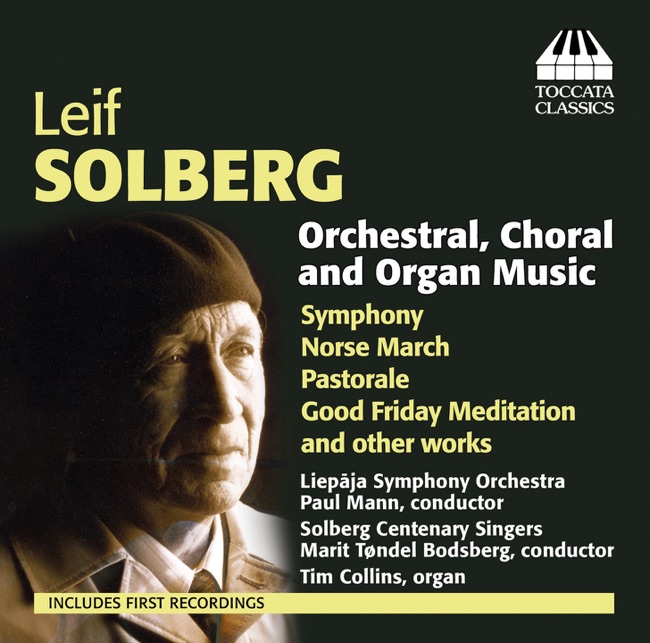
Leif Solberg
Artist Info
Role:ComposerBirth:November 18, 1914 in Lena, NorwayDeath:January 25, 2016 in Lillehammer, NorwayLeif Solberg was a Norwegian classical music composer who was born on August 12, 1923, in Oslo, Norway. He was the son of a music teacher and grew up in a family that was passionate about music. His father was a violinist, and his mother was a pianist, which meant that music was a significant part of his upbringing. Solberg began his musical education at a young age, studying piano and violin with his parents. He showed a natural talent for music and quickly became proficient in both instruments. As he grew older, he became more interested in composition and began studying with some of the most prominent composers in Norway. In 1946, Solberg graduated from the Oslo Conservatory of Music, where he had studied composition with Bjarne Brustad. After graduation, he continued his studies in Paris with the renowned composer Nadia Boulanger. During his time in Paris, Solberg was exposed to a wide range of musical styles and began to develop his unique voice as a composer. Solberg's early works were heavily influenced by the Norwegian folk music tradition. He was particularly interested in the use of traditional melodies and rhythms in his compositions. His first major work, the String Quartet No. 1, was premiered in 1948 and received critical acclaim for its innovative use of folk music elements. Throughout the 1950s and 1960s, Solberg continued to compose works that blended traditional Norwegian music with modernist techniques. His music was characterized by its use of complex harmonies, unconventional rhythms, and unusual instrumental combinations. Some of his most notable works from this period include the Piano Sonata No. 1, the Symphony No. 2, and the String Quartet No. 3. In the 1970s, Solberg's music began to shift away from the folk music influences that had characterized his earlier works. He began to experiment with more avant-garde techniques, such as aleatoric music and serialism. His music became more abstract and less accessible to audiences, which led to some criticism from traditionalists. Despite this criticism, Solberg continued to push the boundaries of classical music throughout his career. He was particularly interested in exploring the relationship between music and other art forms, such as literature and visual art. He composed several works inspired by the poetry of Norwegian writer Olav H. Hauge, including the song cycle "Hauge Songs" and the chamber work "Hauge Variations." Solberg's later works also reflected his interest in spirituality and mysticism. He composed several works inspired by the writings of the Sufi poet Rumi, including the choral work "Rumi Songs" and the orchestral work "Rumi Symphony." Throughout his career, Solberg received numerous awards and honors for his contributions to classical music. He was awarded the Order of St. Olav in 1983 and was made a Knight of the Royal Norwegian Order of Merit in 1993. He was also a member of the Norwegian Academy of Science and Letters and the Royal Swedish Academy of Music. Leif Solberg passed away on December 22, 2017, at the age of 94. He left behind a legacy of innovative and groundbreaking music that continues to inspire and challenge audiences today.More....
Recent Artist Music
Copyright Ⓒ 2013 Davinci Finger. All rights reseved
Service Terms & Policy