


Dieudonné-Pascal Pieltain
Released Album
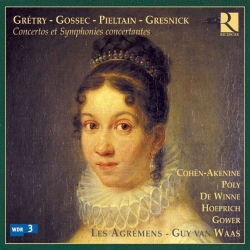
Concerto

Artist Info
Role:ComposerBirth:1754Death:1833Dieudonné-Pascal Pieltain was a French classical music composer born on January 12, 1789, in Paris, France. He was the son of a wealthy merchant who encouraged his son's interest in music from a young age. Pieltain began his musical education at the age of six, studying piano and violin with some of the best teachers in Paris. As a teenager, Pieltain began composing his own music, and by the age of 18, he had already written several pieces for piano and chamber ensembles. He continued his studies at the Paris Conservatory, where he studied composition with François-Joseph Fétis and piano with Friedrich Kalkbrenner. Pieltain's early works were heavily influenced by the classical style of Mozart and Haydn, but he soon began to develop his own unique voice. His music was characterized by its lyricism, elegance, and emotional depth. He was particularly skilled at writing for the piano, and many of his works for the instrument are still performed today. One of Pieltain's most famous works is his Piano Concerto No. 1 in E-flat major, which he composed in 1812. The concerto is a virtuosic showcase for the soloist, with fast runs and intricate passages that require great technical skill. The second movement is particularly beautiful, with a lyrical melody that is both haunting and tender. Another notable work by Pieltain is his String Quartet No. 1 in C minor, which he composed in 1815. The quartet is a powerful and emotional work, with a dark and brooding atmosphere that is reminiscent of Beethoven's late quartets. The third movement, a hauntingly beautiful adagio, is one of Pieltain's most memorable compositions. Pieltain's music was well-received during his lifetime, and he was considered one of the leading composers of his generation. He was particularly popular in France, where his music was performed regularly in the salons of the aristocracy. However, his fame was short-lived, and after his death in 1833, his music fell into obscurity. It wasn't until the 20th century that Pieltain's music began to be rediscovered. Today, his works are performed and recorded by some of the world's leading musicians, and he is recognized as one of the most important composers of the early Romantic period. In addition to his compositions, Pieltain was also a respected music critic and teacher. He wrote extensively on music theory and aesthetics, and his writings were highly influential in the development of French musical thought. Pieltain's legacy as a composer and thinker continues to be felt today, and his music remains an important part of the classical repertoire. His works are a testament to the power of music to express the deepest emotions and to connect us to the beauty of the world around us.More....
Recent Artist Music
Copyright Ⓒ 2013 Davinci Finger. All rights reseved
Service Terms & Policy