


Jean-François-Victor Bellon
Released Album
Chamber
-
 September 11, 2015
 -
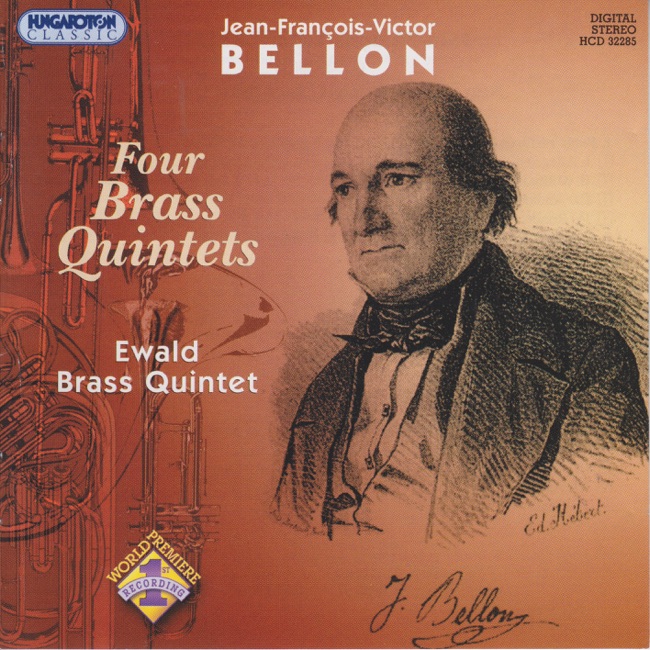 April 26, 2005
Artist Info
Role:ComposerCountry: FranceBirth:May 30, 1795 in Lyon, FranceDeath:March 2, 1869 in Paris, FranceJean-François-Victor Bellon was a French composer born on August 23, 1805, in the city of Marseille. He was the son of a musician, and his father's influence played a significant role in his musical development. Bellon began his musical education at a young age, studying the piano and violin with his father. He showed great promise as a musician, and by the age of 14, he was already performing in public concerts. In 1822, Bellon moved to Paris to further his musical studies. He enrolled at the Paris Conservatory, where he studied composition with Luigi Cherubini and counterpoint with Anton Reicha. Bellon was an exceptional student, and he won several prizes during his time at the conservatory. In 1827, he won the prestigious Prix de Rome, which allowed him to study in Italy for three years. During his time in Italy, Bellon was exposed to the works of the great Italian composers, including Rossini, Donizetti, and Bellini. He was particularly drawn to the bel canto style of opera, which emphasized beautiful melodies and vocal virtuosity. Bellon was also influenced by the works of the German composer Carl Maria von Weber, who was known for his innovative use of orchestration. After returning to Paris in 1830, Bellon began to establish himself as a composer. He wrote several operas, including La Fille du Danube (1836) and Les Noces de Gamache (1841), which were well-received by audiences and critics alike. Bellon's music was characterized by its lyricism and elegance, as well as its innovative use of orchestration. In addition to his operas, Bellon also wrote several works for the concert hall. His Symphony in D minor (1838) was particularly well-regarded, and it was performed by several of the leading orchestras of the day. Bellon's music was also popular in the salons of Paris, where it was often performed by amateur musicians. Despite his success as a composer, Bellon struggled financially throughout his life. He was never able to secure a permanent position at the Paris Conservatory, and he relied on commissions and performances to make a living. Bellon's financial difficulties were compounded by his poor health. He suffered from tuberculosis, which eventually led to his death on December 22, 1866, at the age of 61. Despite his relatively short life and limited output, Bellon's music had a significant impact on the development of French classical music. His operas helped to establish the French tradition of lyric opera, which would later be exemplified by the works of composers such as Gounod and Massenet. Bellon's innovative use of orchestration also influenced later composers, including Debussy and Ravel. Today, Bellon's music is not as well-known as that of some of his contemporaries, but it remains an important part of the French classical music tradition. His works are still performed occasionally, and they continue to be admired for their elegance, lyricism, and innovative use of orchestration. Bellon's legacy as a composer and innovator in the world of classical music is secure, and his contributions to the development of French music will continue to be appreciated for generations to come.More....
Recent Artist Music


Copyright Ⓒ 2013 Davinci Finger. All rights reseved
Service Terms & Policy