


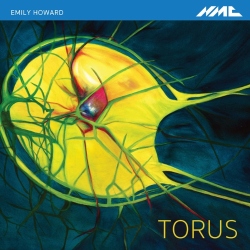
Emily Howard
Released Album
Chamber
-
 March 25, 2022
 -
 February 16, 2018
 -
 August 24, 2016
Artist Info
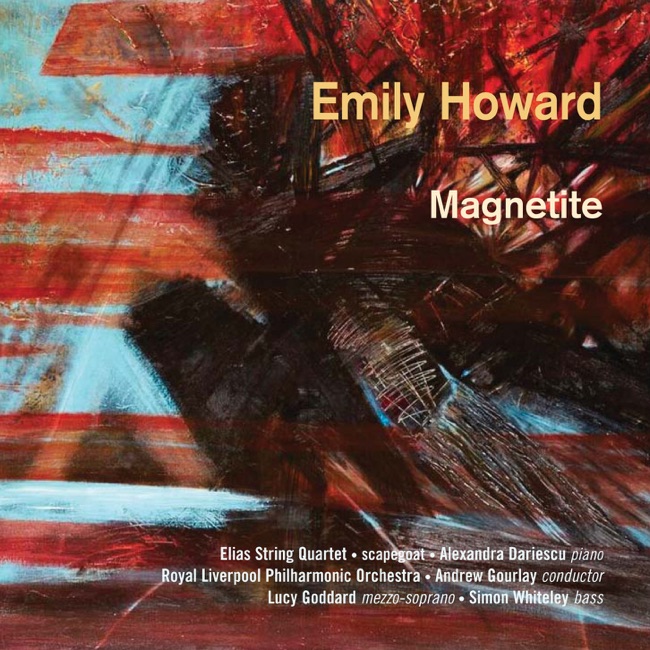
Role:ComposerBirth:1979Emily Howard is a British composer who has made a significant impact on the classical music scene. Born in Liverpool in 1979, Howard grew up in a family of musicians. Her father was a jazz pianist, and her mother was a singer. Howard began playing the piano at a young age and showed a natural talent for music. Howard attended the University of Sheffield, where she studied music and composition. She went on to earn a PhD in composition from the University of Manchester. During her studies, Howard was influenced by the works of composers such as Olivier Messiaen, György Ligeti, and Karlheinz Stockhausen. Howard's early works were experimental and avant-garde, reflecting her interest in contemporary music. Her first major composition, "Mesmerism," was written in 2001 and premiered at the Huddersfield Contemporary Music Festival. The piece was inspired by the work of Franz Mesmer, a German physician who developed a theory of animal magnetism in the 18th century. In 2005, Howard was commissioned by the Royal Liverpool Philharmonic Orchestra to write a piece for their 175th anniversary. The resulting work, "Magnetite," was a symphonic poem that explored the properties of the mineral magnetite. The piece was well-received and established Howard as a rising star in the classical music world. Howard's music continued to evolve, incorporating elements of electronic music and rock. Her 2010 work "Calculus of the Nervous System" was a collaboration with the rock band These New Puritans. The piece was performed at the Barbican Centre in London and received critical acclaim. In 2012, Howard was commissioned by the BBC Proms to write a piece for their annual festival. The resulting work, "Solar," was a tribute to the sun and its role in the universe. The piece was performed by the BBC Symphony Orchestra and featured a large choir and electronic elements. "Solar" was a major success and cemented Howard's reputation as one of the most innovative composers of her generation. Howard's music has been performed by some of the world's leading orchestras, including the London Symphony Orchestra, the New York Philharmonic, and the Berlin Philharmonic. She has won numerous awards for her work, including the Paul Hamlyn Foundation Award for Composers in 2013. In addition to her work as a composer, Howard is also a professor of composition at the Royal Northern College of Music in Manchester. She is passionate about teaching and mentoring young composers, and has been a mentor for the London Symphony Orchestra's Panufnik Scheme. Howard's music is characterized by its complexity and innovation. She is known for her use of electronic elements and her incorporation of scientific concepts into her compositions. Her works often explore the relationship between music and science, and she has collaborated with scientists and mathematicians on several projects. Some of Howard's most notable works include "Afference," a piece for orchestra and electronics that explores the concept of sensory input, and "Torque," a work for string quartet that was inspired by the physics of rotation. Her most recent work, "Sphere," is a multimedia piece that combines music, dance, and visual art to explore the concept of the universe as a sphere. Emily Howard is a composer who has pushed the boundaries of classical music and brought new ideas and perspectives to the genre.More....

Copyright Ⓒ 2013 Davinci Finger. All rights reseved
Service Terms & Policy