


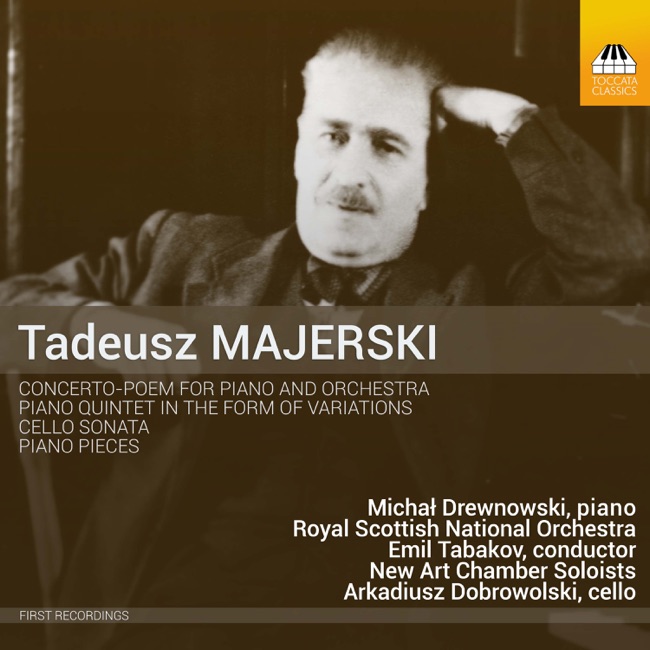
Tadeusz Majerski
Released Album
Keyboard
-
 September 7, 2018
Artist Info
Role:ComposerBirth:1888Death:1963Tadeusz Majerski was a Polish composer and pianist who lived from 1898 to 1988. He was born in the city of Krakow, which was then part of the Austro-Hungarian Empire. Majerski showed an early aptitude for music, and began studying piano at the age of six. He went on to study at the Krakow Conservatory, where he was a pupil of the composer and pianist Karol Szymanowski. Majerski's early compositions were heavily influenced by Szymanowski's style, which was characterized by a blend of traditional Polish folk music and modernist techniques. Majerski's first major work was his Piano Sonata No. 1, which he composed in 1921. The piece was well-received by critics, who praised its technical virtuosity and emotional depth. Throughout the 1920s and 1930s, Majerski continued to compose prolifically, producing a wide range of works for piano, chamber ensemble, and orchestra. His music was often performed in Poland and other European countries, and he became known as one of the leading composers of his generation. One of Majerski's most famous works is his Piano Concerto No. 1, which he composed in 1933. The piece is notable for its complex harmonies and intricate rhythms, as well as its use of Polish folk melodies. The concerto was premiered in Warsaw in 1934, with Majerski himself as the soloist. It was an immediate success, and has since become one of the most frequently performed works in the Polish classical music repertoire. During World War II, Majerski was forced to flee Poland due to the Nazi occupation. He spent several years in exile in the United States, where he continued to compose and perform. In 1946, he returned to Poland and resumed his career as a composer and pianist. In the post-war years, Majerski's music underwent a significant change. He began to incorporate more traditional Polish folk elements into his compositions, and his style became more accessible and tonal. One of his most famous works from this period is his Symphony No. 2, which he composed in 1951. The piece is characterized by its lush orchestration and use of Polish folk melodies. Majerski continued to compose and perform throughout the 1950s and 1960s, and his music remained popular with audiences in Poland and abroad. In 1968, he was awarded the State Prize for his contributions to Polish culture. Majerski's later works were marked by a return to the more modernist style of his early career. He continued to experiment with new techniques and forms, and his music remained highly regarded by critics and audiences alike. He died in Krakow in 1988, leaving behind a legacy as one of Poland's most important composers of the 20th century.More....

Copyright Ⓒ 2013 Davinci Finger. All rights reseved
Service Terms & Policy