


Alexander Rapoport
Artist Info
Role:ComposerBirth:1957 in Ann Arbor, MIAlexander Rapoport was a Russian-born classical music composer who was born on December 31, 1957, in Moscow, Russia. He was born into a family of musicians, and his father was a well-known composer and conductor. From a young age, Rapoport showed a keen interest in music, and he began studying the piano and composition at the age of six. Rapoport's early musical education was heavily influenced by the Russian classical music tradition, and he was particularly drawn to the works of Tchaikovsky, Rachmaninoff, and Shostakovich. He attended the Moscow Conservatory, where he studied composition under the tutelage of Yuri Kholopov, one of the most prominent music theorists of the time. During his time at the conservatory, Rapoport began to develop his own unique style of composition, which blended elements of the Russian classical tradition with more modern and experimental techniques. His early works were characterized by their complex harmonies, intricate rhythms, and unconventional use of instrumentation. After graduating from the conservatory, Rapoport began to gain recognition as a composer, and his works were performed by some of the most prestigious orchestras and ensembles in Russia. In 1989, he was awarded the prestigious Glinka State Prize for his composition "Symphony No. 1," which was hailed as a masterpiece of contemporary classical music. Throughout the 1990s and early 2000s, Rapoport continued to compose prolifically, producing a wide range of works for orchestra, chamber ensembles, and solo instruments. His music was characterized by its emotional intensity, technical virtuosity, and innovative use of musical form. One of Rapoport's most notable works from this period was his "Concerto for Violin and Orchestra," which was premiered in 1995 by the Moscow Philharmonic Orchestra. The piece was praised for its lyrical beauty, technical difficulty, and innovative use of orchestration. In addition to his work as a composer, Rapoport was also a respected music educator, and he taught composition and music theory at the Moscow Conservatory for many years. He was known for his rigorous teaching style and his ability to inspire his students to push the boundaries of classical music. In 2005, Rapoport moved to the United States, where he continued to compose and teach. He quickly established himself as one of the leading composers of contemporary classical music in the country, and his works were performed by some of the most prestigious orchestras and ensembles in the United States. One of Rapoport's most notable works from this period was his "Symphony No. 2," which was premiered by the New York Philharmonic in 2010. The piece was hailed as a masterpiece of contemporary classical music, and it cemented Rapoport's reputation as one of the most innovative and influential composers of his generation. Throughout his career, Rapoport remained committed to pushing the boundaries of classical music and exploring new forms of expression. His works were characterized by their emotional intensity, technical virtuosity, and innovative use of musical form, and they continue to be performed and celebrated by musicians and audiences around the world.More....
Recent Artist Music
1
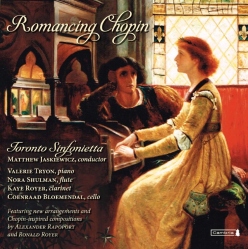
Variation on a Theme of Chopin (based on 'Prelude in C minor, Op. 28/20')
Variation on a Theme of Chopin for Piano and Chamber Orchestra, based on the Prelude in C Minor, Op. 28, No. 20
12:41
Copyright Ⓒ 2013 Davinci Finger. All rights reseved
Service Terms & Policy