


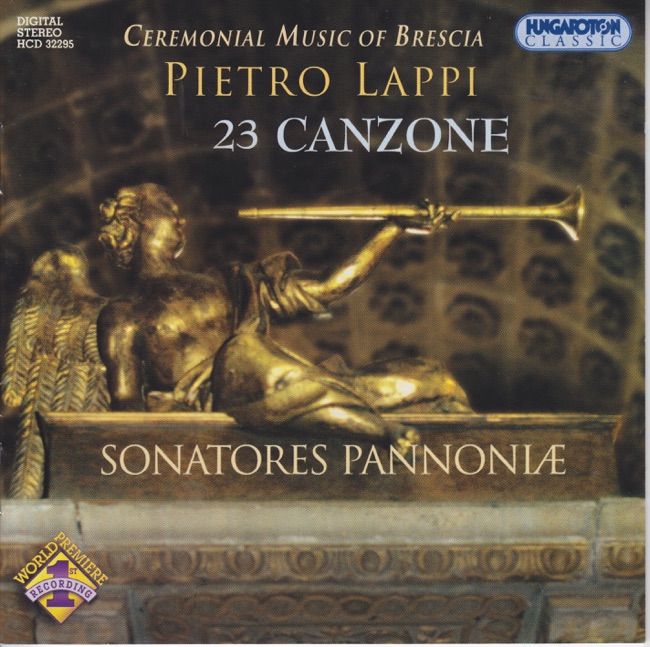
Pietro Lappi
Released Album
Chamber
-
 August 12, 2014
 -
 April 28, 2009
 -
 October 29, 2004
 -
 January 5, 2003
Artist Info
Role:ComposerCountry: ItalyBirth:1575Death:1630Period:RenaissanceGenre:ChamberPietro Lappi was a prominent Italian composer of the late Renaissance and early Baroque periods. He was born in Verona, Italy, in 1575, and little is known about his early life and musical training. However, it is believed that he received his education in music from the local cathedral in Verona, where he served as a choirboy. Lappi's early compositions were primarily vocal works, including motets and madrigals. He also wrote a number of instrumental pieces, including dances and canzonas. His music was heavily influenced by the works of other Italian composers of the time, such as Giovanni Gabrieli and Claudio Monteverdi. In 1604, Lappi was appointed as the maestro di cappella at the Basilica di San Marco in Venice, one of the most prestigious musical positions in Italy at the time. During his time in Venice, Lappi composed a number of works for the church, including masses, psalms, and hymns. He also wrote a number of secular works, including madrigals and instrumental pieces. One of Lappi's most famous works is his Missa brevis, a short mass for four voices and organ. The mass is notable for its use of polychoral techniques, which were popular in Venice at the time. The mass is also notable for its use of chromaticism, which was a relatively new technique in the early Baroque period. Lappi's other notable works include his Canzoni per sonare con ogni sorte di stromenti, a collection of instrumental canzonas for various instruments, and his Madrigali a cinque voci, a collection of five-part madrigals. Both of these works showcase Lappi's skill as a composer and his ability to write for a variety of instruments and voices. Despite his success as a composer, Lappi's life was not without its challenges. In 1613, he was accused of embezzlement and was forced to leave his position at the Basilica di San Marco. He returned to Verona, where he continued to compose and teach music. However, he never regained the level of success he had achieved in Venice. Lappi died in Verona in 1630, at the age of 55. Despite his relatively short life, he left behind a significant body of work that continues to be performed and studied today. His music is notable for its use of polychoral techniques, chromaticism, and expressive harmonies, which were all hallmarks of the early Baroque period.More....
Recent Artist Music
5
Song La Federica, Op. 9
Canzon nona La Federica (Canzoni da suonare a 4 - 13 stromenti, Libro uno, Venezia 1606)
2:34
6
Songs to play, at 4-13, Op. 9
Canzon undecima 'La Serafina' a 4 (from Canzoni per sonare, 1608)
2:43
Copyright Ⓒ 2013 Davinci Finger. All rights reseved
Service Terms & Policy