


Johannes Cornago
Released Album
Vocal
-
 September 29, 2023
 -
 September 11, 2012
 -
 March 27, 2001
Choral
-
 June 12, 2001
Miscellaneous
-
-
 April 1, 1992
Artist Info
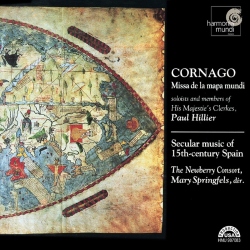
Role:ComposerCountry: SpainDeath:1455Period:RenaissanceGenre:ChoralVocalJohannes Cornago was a Spanish composer of the Renaissance period, born in the late 15th century in Valencia, Spain. Not much is known about his early life, but it is believed that he received his musical education in the Cathedral of Valencia, where he later became a singer and a composer. Cornago's musical career flourished during the reign of King Ferdinand II of Aragon, who was a great patron of the arts. Cornago was appointed as a singer in the royal chapel in 1498, and he remained in this position until 1506. During this time, he also served as a music teacher to the royal children. Cornago's compositions were highly regarded during his lifetime, and he was considered one of the most important composers of his time. His music was characterized by its intricate polyphony and its use of complex rhythms and harmonies. He was particularly known for his motets, which were religious choral works that were often performed in the royal chapel. One of Cornago's most famous works is his motet "Quis dabit oculis," which was written in honor of King Ferdinand II. This piece is notable for its use of a canon, which is a musical technique where one voice imitates another at a fixed interval. The canon in "Quis dabit oculis" is particularly complex, as it involves three voices singing in canon at different intervals. Another notable work by Cornago is his "Missa de la mapa mundi," which is a mass that is based on a popular medieval map of the world. This mass is notable for its use of musical symbolism, as each section of the mass is associated with a different part of the world. For example, the Kyrie is associated with Europe, the Gloria with Asia, and the Credo with Africa. Cornago's music was highly influential in his time, and it had a significant impact on the development of music in Spain and throughout Europe. His use of complex rhythms and harmonies was particularly influential, and it paved the way for the development of the Baroque period of music. Despite his significant contributions to music, Cornago's life and work have been largely forgotten over time. However, his music continues to be performed and studied by scholars and musicians today, and it remains an important part of the musical canon of the Renaissance period.More....
Recent Artist Music
3
3:37
6
3:16
9
4:2
14
Que's mi vida, preguntays
Qu'es mi vida - plus four part arr. by Johannes Ockeghem (c.1410-1497)
2:13
Copyright Ⓒ 2013 Davinci Finger. All rights reseved
Service Terms & Policy