


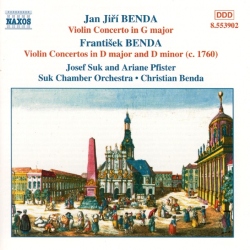
Johann Georg (Jan Jirí) Benda
Released Album
Concerto
-
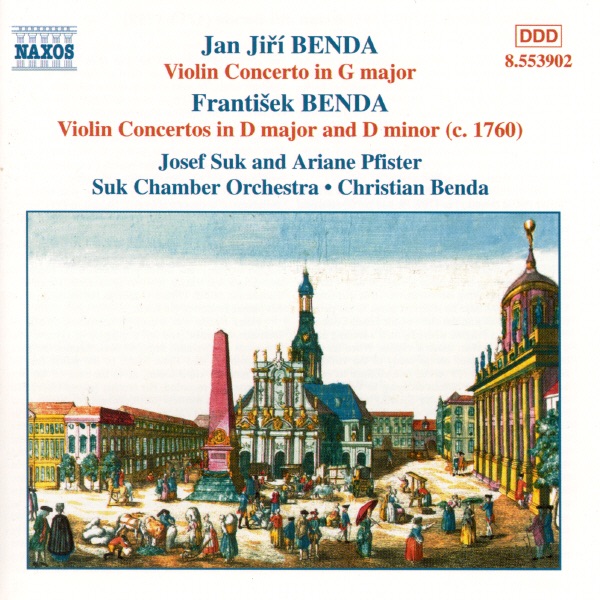 October 1, 2001
 -
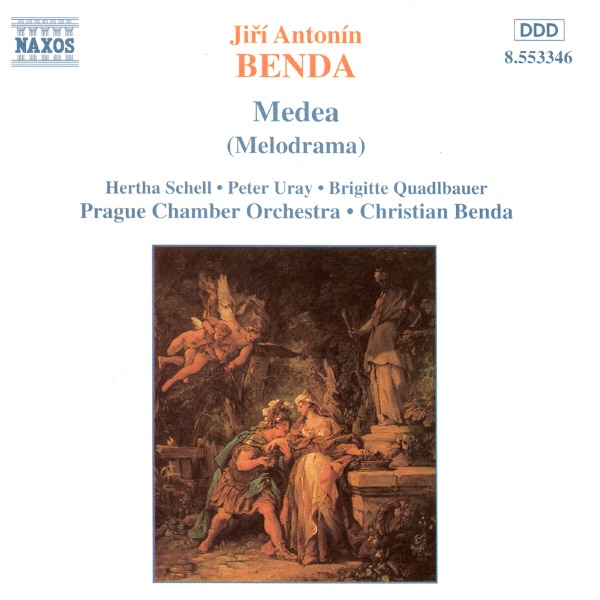 July 9, 1996
Artist Info
Role:ComposerBirth:April 25, 1686 in MsteticeDeath:December 4, 1757 in Potsdam, GermanyPeriod:BaroqueGenre:ConcertoJohann Georg (Jan Jirí) Benda was a prominent classical music composer of the 18th century. He was born on June 30, 1722, in the small town of Staré Benátky, located in the present-day Czech Republic. Benda was born into a family of musicians, and his father, Jan Jiří Benda, was a well-known violinist and composer. Benda's mother, Dorota Brixi, was also a musician and composer. Benda's musical education began at an early age, and he received his first music lessons from his father. He showed great talent and quickly became proficient in playing the violin, the harpsichord, and the viola da gamba. Benda's father recognized his son's talent and encouraged him to pursue a career in music. In 1739, Benda moved to Prague to study music at the Charles University. He studied under the renowned composer Johann Joseph Fux, who was the court composer of the Holy Roman Emperor Charles VI. Benda's studies with Fux were instrumental in shaping his musical style and technique. After completing his studies, Benda began his career as a composer and musician. He worked as a violinist and composer in various courts across Europe, including the court of Frederick the Great in Berlin. Benda's music was well-received, and he quickly gained a reputation as a talented composer. Benda's music was characterized by its emotional depth and expressiveness. He was known for his use of chromaticism and his ability to create complex harmonies. Benda's music was also influenced by the emerging classical style, which emphasized clarity, simplicity, and balance. Benda's most famous works include his operas, which were popular throughout Europe. His first opera, Xindo riconosciuto, was premiered in Prague in 1749. The opera was a great success, and it was performed in various cities across Europe. Benda's other operas include Ariadne auf Naxos, Medea, and Pygmalion. In addition to his operas, Benda also composed instrumental music, including symphonies, concertos, and chamber music. His instrumental music was characterized by its virtuosity and technical complexity. Benda's most famous instrumental works include his Violin Concerto in D major and his Symphony in G major. Benda's music was highly regarded by his contemporaries, and he was considered one of the leading composers of his time. His music was influential in the development of the classical style, and his operas were an important precursor to the works of Mozart and Gluck. Benda continued to compose music throughout his life, and he remained active as a musician until his death on November 6, 1795. His legacy as a composer and musician continues to be celebrated today, and his music remains an important part of the classical music canon.More....

Copyright Ⓒ 2013 Davinci Finger. All rights reseved
Service Terms & Policy