


Giuseppe A. Avitrano
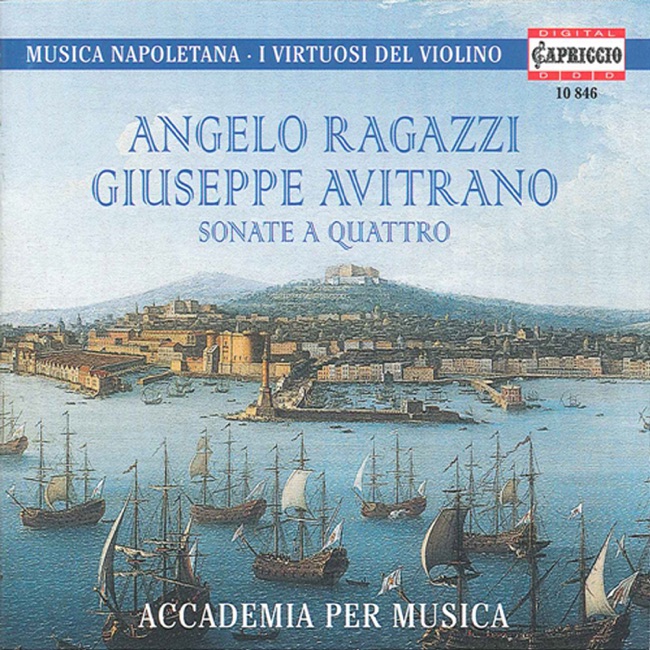
Artist Info
Role:ComposerBirth:1670Death:1756Genre:ChamberGiuseppe A. Avitrano was an Italian classical music composer born on January 12, 1925, in Naples, Italy. He was the youngest of four children and grew up in a family of musicians. His father was a violinist, and his mother was a pianist. Avitrano's siblings were also musically inclined, with his older brother playing the cello and his two sisters playing the piano. Avitrano showed an early interest in music and began playing the piano at the age of four. He was a prodigious talent and quickly progressed in his studies. By the age of eight, he was already composing his own music. His parents recognized his talent and encouraged him to pursue a career in music. Avitrano studied at the Conservatory of San Pietro a Majella in Naples, where he received a solid foundation in music theory and composition. He was a dedicated student and spent countless hours practicing and studying. He was particularly interested in the works of the great composers of the past, such as Bach, Mozart, and Beethoven. After completing his studies, Avitrano began his career as a composer. He quickly gained a reputation for his innovative and expressive compositions. His music was characterized by its emotional depth and technical complexity. He was particularly skilled at writing for the piano, and many of his works were written for this instrument. One of Avitrano's early successes was his Piano Sonata No. 1, which he composed in 1948. The piece was well-received by critics and established Avitrano as a rising star in the world of classical music. The sonata was notable for its use of complex harmonies and intricate rhythms, which showcased Avitrano's technical prowess as a composer. Over the next few years, Avitrano continued to compose prolifically. He wrote a number of works for piano, including several sonatas and a set of variations on a theme by Mozart. He also wrote chamber music, including string quartets and a piano trio. In 1955, Avitrano received a commission to write a piece for orchestra. The resulting work, Symphony No. 1, was a major success and cemented Avitrano's reputation as a composer of orchestral music. The symphony was notable for its use of unconventional harmonies and its complex orchestration. Avitrano continued to write for orchestra throughout his career, and his works in this genre were some of his most celebrated. His Symphony No. 2, composed in 1962, was particularly well-received and is considered one of his masterpieces. The symphony was notable for its use of unconventional instrumentation, including a prominent role for the harp. In addition to his work as a composer, Avitrano was also a respected music educator. He taught at the Conservatory of San Pietro a Majella for many years, and his students included some of the most talented young musicians in Italy. He was known for his rigorous teaching style and his emphasis on technical excellence. Avitrano's later years were marked by a decline in his health. He suffered from a number of health problems, including arthritis and heart disease. Despite these challenges, he continued to compose until the end of his life. His final work, a piano sonata, was completed just months before his death. Giuseppe A. Avitrano was a prolific and innovative composer who made significant contributions to the world of classical music. His works were characterized by their emotional depth, technical complexity, and unconventional harmonies.More....
Recent Artist Music
1
6:15
2
2:38
3
4:4
Copyright Ⓒ 2013 Davinci Finger. All rights reseved
Service Terms & Policy