


Abel Ehrlich
Released Album
Chamber
-
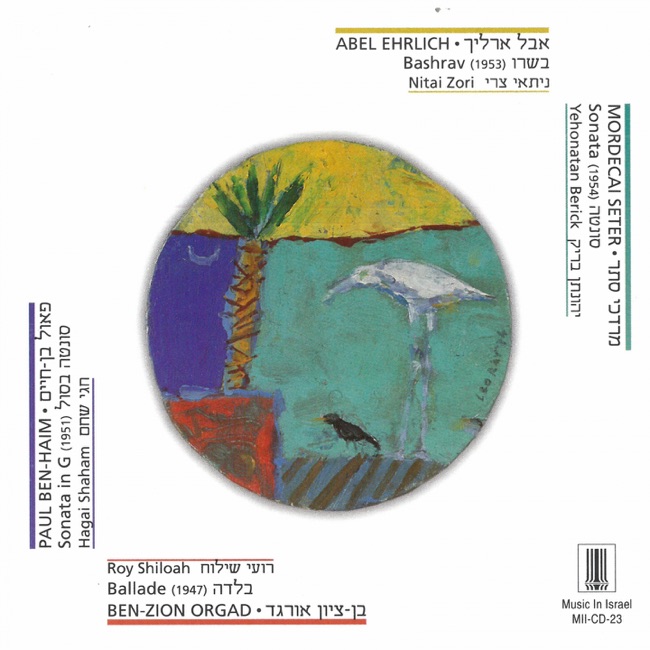
-
 February 14, 2006
Choral
-
 April, 1996
Artist Info
Role:ComposerCountry: IsraelBirth:September 3, 1915 in Cranz, East PrussiaDeath:October 30, 2003 in Tel Aviv, IsraelAbel Ehrlich was a renowned classical music composer, born on January 19, 1915, in the city of Vilnius, Lithuania. He was born into a family of musicians, and his father was a well-known cantor in the Jewish community. Ehrlich's early exposure to music and his family's musical background played a significant role in shaping his musical career. Ehrlich's family moved to Berlin, Germany, when he was a child, and he began his formal music education at the age of six. He studied piano, violin, and composition at the Berlin Conservatory, where he was a student of the renowned composer Paul Hindemith. Ehrlich's early compositions were influenced by Hindemith's neoclassical style, and he developed a reputation as a promising young composer. In 1933, Ehrlich's family fled Germany due to the rise of the Nazi regime, and they settled in Palestine. Ehrlich continued his music education at the Jerusalem Academy of Music and Dance, where he studied composition with the composer and conductor Paul Ben-Haim. Ehrlich's compositions during this period were influenced by Jewish folk music and the landscape of Palestine. Ehrlich's career as a composer took off in the 1950s, and he became known for his unique blend of Jewish and Western classical music. His compositions often featured Jewish themes and motifs, and he was known for his use of unconventional instruments, such as the shofar (a Jewish ritual horn) and the accordion. One of Ehrlich's most famous works is his oratorio "The Dybbuk," which was composed in 1974. The piece is based on a play by S. Ansky and tells the story of a young bride possessed by the spirit of her dead lover. The oratorio features a large orchestra, choir, and soloists, and it has been performed by orchestras around the world. Another notable work by Ehrlich is his "Concerto for Accordion and Orchestra," which was composed in 1963. The piece features the accordion as a solo instrument and showcases Ehrlich's unique blend of Jewish and Western classical music. Ehrlich's music has been performed by some of the world's leading orchestras, including the Israel Philharmonic Orchestra, the Berlin Philharmonic Orchestra, and the New York Philharmonic. He was also a prolific composer of film scores, and his music was featured in several Israeli films. In addition to his work as a composer, Ehrlich was also a respected music educator. He taught composition at the Jerusalem Academy of Music and Dance and was a mentor to many young composers. Ehrlich's contributions to the world of classical music were recognized with numerous awards and honors. He was awarded the Israel Prize for Music in 1987, and he was also a recipient of the ACUM Lifetime Achievement Award. Abel Ehrlich passed away on June 24, 2003, at the age of 88. His legacy as a composer and educator continues to inspire musicians around the world, and his unique blend of Jewish and Western classical music remains an important part of the classical music canon.More....
Recent Artist Music


Copyright Ⓒ 2013 Davinci Finger. All rights reseved
Service Terms & Policy