


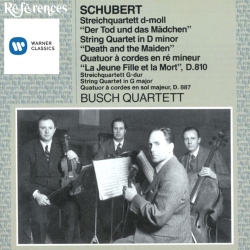
Busch Quartet
Released Album
Chamber
-

-
 March 6, 2021
 -
 January 30, 2021
 -
 November 30, 2019
 -
 April 26, 2019
 -

Artist Info
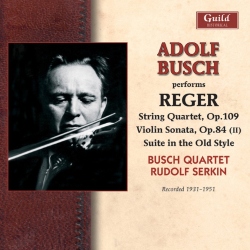
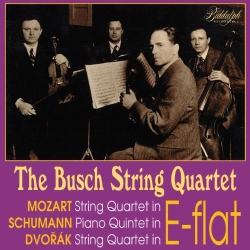
The Busch Quartet was a renowned classical music ensemble that was active from 1912 to 1951. The quartet was named after its founder, the violinist Adolf Busch, and was known for its exceptional musicianship and innovative interpretations of classical music. Adolf Busch was born in Germany in 1891 and began playing the violin at a young age. He studied at the Cologne Conservatory and later at the Hochschule für Musik in Berlin. In 1912, he founded the Busch Quartet with three other musicians: Gösta Andreasson (violin), Karl Doktor (viola), and Paul Grümmer (cello). The quartet quickly gained a reputation for its technical precision and emotional depth, and it became one of the most celebrated ensembles of its time. The Busch Quartet's repertoire was wide-ranging, encompassing works by classical composers such as Beethoven, Mozart, and Haydn, as well as contemporary composers like Bartók and Schoenberg. The quartet was known for its innovative interpretations of these works, which often emphasized the emotional and expressive aspects of the music. One of the Busch Quartet's most notable performances was its 1935 recording of Beethoven's String Quartet No. 13 in B-flat major, Op. 130. This recording is widely regarded as one of the greatest interpretations of the work ever recorded, and it remains a landmark in the history of classical music. The Busch Quartet also performed extensively throughout Europe and the United States, and it was particularly well-received in England. The quartet made several tours of England in the 1930s, and it became a favorite of British audiences and critics alike. The quartet's performances at the Edinburgh Festival in 1934 and 1935 were particularly well-received, and they helped to establish the Busch Quartet as one of the leading ensembles of its time. In addition to its performances, the Busch Quartet also made numerous recordings throughout its career. Its recordings of the Beethoven string quartets are particularly highly regarded, and they remain some of the most influential recordings of these works ever made. Despite its success, the Busch Quartet faced numerous challenges throughout its career. The outbreak of World War II forced the quartet to disband temporarily, and it was not until 1945 that the ensemble was able to resume its performances. In addition, the quartet's members faced personal challenges, including the death of Paul Grümmer in 1946. Despite these challenges, the Busch Quartet continued to perform and record until its final concert in 1951. The quartet's legacy lives on, however, through its numerous recordings and the influence it had on subsequent generations of classical musicians. The Busch Quartet remains one of the most celebrated ensembles in the history of classical music, and its innovative interpretations and exceptional musicianship continue to inspire and captivate audiences today.More....
Recent Artist Music










15
11:33
Copyright Ⓒ 2013 Davinci Finger. All rights reseved
Service Terms & Policy