


Harald Banter
Released Album
Orchestral
-
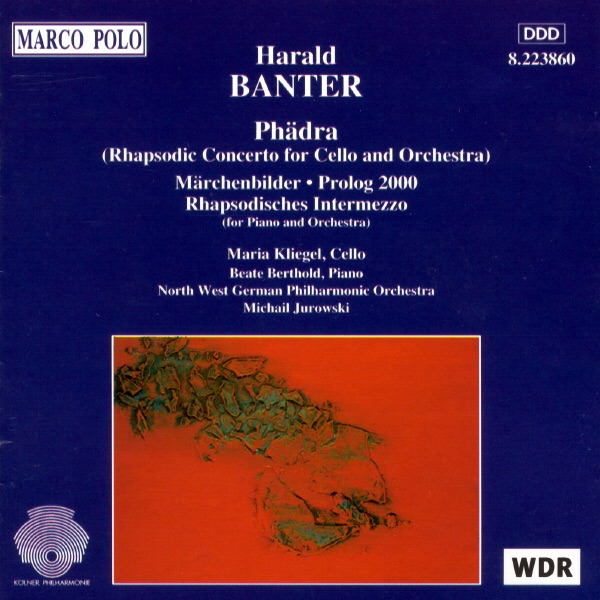 November 19, 1996
Keyboard
-
 May 26, 2015
Artist Info
Role:ComposerGenre:Avant-GardeConcertoOperaOrchestralHarald Banter was a German composer born on January 12, 1927, in the city of Frankfurt. He was the youngest of three children born to a family of musicians. His father was a violinist, and his mother was a pianist. Banter's siblings were also musically inclined, with his brother playing the cello and his sister playing the violin. Banter's parents recognized his musical talent at an early age and encouraged him to pursue music. He began playing the piano at the age of four and started composing his own music by the age of six. Banter's parents provided him with a solid musical education, and he studied piano, composition, and music theory with some of the best teachers in Frankfurt. In 1945, Banter's family was forced to flee Frankfurt due to the bombings of World War II. They settled in the town of Bad Homburg, where Banter continued his musical studies. He attended the Hoch Conservatory in Frankfurt, where he studied composition with Wolfgang Fortner and piano with Kurt Hessenberg. Banter's early compositions were heavily influenced by the music of Bach, Beethoven, and Brahms. He was also influenced by the music of contemporary composers such as Bartok, Stravinsky, and Schoenberg. Banter's music was characterized by its complexity and its use of unconventional harmonies and rhythms. In 1952, Banter won the prestigious Kranichsteiner Musikpreis, which brought him national recognition in Germany. This award was given to young composers who showed exceptional talent and promise. Banter's winning composition was a piano sonata that showcased his technical skill and his unique musical voice. Throughout the 1950s and 1960s, Banter continued to compose music that was well-received by audiences and critics alike. He wrote music for a variety of ensembles, including orchestras, chamber groups, and solo instruments. Some of his most notable works from this period include his Symphony No. 1, his String Quartet No. 1, and his Piano Concerto No. 1. Banter's music was known for its complexity and its use of unconventional harmonies and rhythms. He often used serialism and other modernist techniques in his compositions. However, Banter's music was not purely academic; it was also emotional and expressive. He was able to balance his technical skill with his artistic vision, creating music that was both challenging and accessible. In the 1970s, Banter's music began to shift away from the modernist style that had characterized his earlier works. He began to incorporate more tonal elements into his music, and his compositions became more accessible to a wider audience. Some of his most notable works from this period include his Symphony No. 2, his String Quartet No. 2, and his Piano Concerto No. 2. Banter continued to compose music well into his later years. He wrote music for a variety of ensembles, including orchestras, chamber groups, and solo instruments. Some of his most notable works from this period include his Symphony No. 3, his String Quartet No. 3, and his Piano Concerto No. 3. Banter's music has been performed by some of the world's leading orchestras and ensembles. His compositions have been praised for their technical skill, their emotional depth, and their unique musical voice. Banter's legacy as a composer continues to be felt today, and his music remains an important part of the classical music canon.More....
Recent Artist Music
Copyright Ⓒ 2013 Davinci Finger. All rights reseved
Service Terms & Policy