


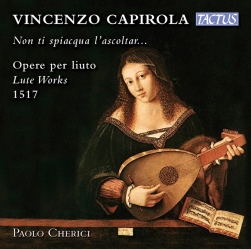
Vicenzo Capriola
Artist Info
Role:ComposerBirth:1474Death:after 1548Period:RenaissanceGenre:ChamberVincenzo Capriola was an Italian composer of the Baroque era, born in Naples in 1659. He was the son of a musician and grew up in a musical family. His father, Francesco Capriola, was a violinist and composer, and his mother, Maria Grazia, was a singer. Vincenzo showed an early interest in music and began studying the violin and composition at a young age. Capriola's musical education was extensive, and he studied with some of the most prominent musicians of his time. He studied composition with Alessandro Scarlatti, who was one of the leading composers of the Baroque era. He also studied the violin with Arcangelo Corelli, who was one of the most famous violinists of the time. Capriola's education was rounded out by studying with other prominent musicians, including Giovanni Battista Bassani and Giovanni Bononcini. Capriola's early compositions were primarily for the violin, and he quickly gained a reputation as a skilled violinist and composer. His compositions were well-received, and he began to gain recognition as a composer of note. In 1685, he was appointed as the maestro di cappella at the Basilica of San Lorenzo Maggiore in Naples, a position he held for several years. During his time as maestro di cappella, Capriola composed a number of works for the church, including masses, motets, and other sacred music. His compositions were known for their beauty and complexity, and they were often performed by the finest musicians of the time. Capriola's music was also popular outside of the church, and he composed a number of secular works as well. One of Capriola's most famous works is his Sonata for Violin and Continuo in D minor. This piece is a beautiful example of Baroque music, with its intricate melodies and complex harmonies. The piece is often performed today and is considered one of Capriola's masterpieces. Capriola's music was also known for its use of counterpoint, a technique that was popular in the Baroque era. Counterpoint involves the use of multiple melodies that are played simultaneously, creating a complex and layered sound. Capriola was a master of this technique, and his compositions are known for their intricate and beautiful counterpoint. Capriola's career was cut short by his untimely death in 1716. He was only 57 years old at the time of his death, but he had already made a significant impact on the world of music. His compositions were widely admired, and he was considered one of the leading composers of his time. Today, Capriola's music is still performed and admired by musicians and music lovers around the world. His compositions are considered some of the finest examples of Baroque music, and his use of counterpoint and other techniques continue to inspire musicians today. Capriola's legacy as a composer and musician is secure, and his contributions to the world of music will be remembered for generations to come.More....
Recent Artist Music
Copyright Ⓒ 2013 Davinci Finger. All rights reseved
Service Terms & Policy