


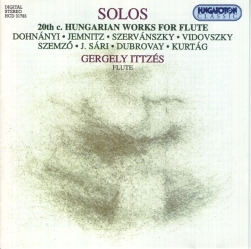
Sándor Jemnitz
Released Album
Chamber
-
 January 28, 2022
 -
 April 14, 2009
Artist Info
Role:ComposerBirth:August 9, 1890Death:August 8, 1963Genre:ChamberSándor Jemnitz was a Hungarian composer and music educator who was born on January 1, 1913, in Budapest, Hungary. He was the son of a music teacher and grew up in a musical family. His father, Lajos Jemnitz, was a well-known music educator and composer, and his mother, Ilona Jemnitz, was a pianist. Sándor Jemnitz showed an early interest in music and began studying the piano and composition at a young age. Jemnitz attended the Franz Liszt Academy of Music in Budapest, where he studied composition with Zoltán Kodály and piano with Béla Bartók. He graduated in 1936 and began his career as a composer and music educator. He taught at several music schools in Hungary, including the Budapest Conservatory and the Franz Liszt Academy of Music. Jemnitz's early compositions were influenced by the folk music of Hungary and other Eastern European countries. He was particularly interested in the use of folk melodies and rhythms in classical music, a style that was popular among Hungarian composers at the time. His early works include the Suite for Orchestra (1935) and the String Quartet No. 1 (1937). During World War II, Jemnitz served in the Hungarian army and was captured by the Soviet Union. He spent several years in a prisoner-of-war camp, where he continued to compose music. After his release, he returned to Hungary and resumed his career as a composer and music educator. In the post-war years, Jemnitz's music became more experimental and modernist. He was influenced by the music of Arnold Schoenberg and other composers of the Second Viennese School. His works from this period include the String Quartet No. 2 (1948) and the Piano Sonata No. 1 (1950). Jemnitz's music was well-received in Hungary and he won several awards for his compositions. In 1951, he was awarded the Kossuth Prize, the highest honor for artists in Hungary. He continued to teach at the Franz Liszt Academy of Music and mentored several young composers, including György Ligeti and György Kurtág. In the 1960s, Jemnitz's music became more experimental and avant-garde. He was interested in electronic music and began incorporating electronic sounds into his compositions. His works from this period include the Electronic Music No. 1 (1963) and the Electronic Music No. 2 (1965). Jemnitz's later works were more introspective and reflective. He was interested in the use of silence and space in music and began incorporating these elements into his compositions. His works from this period include the String Quartet No. 4 (1975) and the Piano Sonata No. 2 (1980). Jemnitz continued to compose music and teach until his death on December 16, 1986, in Budapest, Hungary. He left behind a legacy of innovative and experimental music that continues to influence composers today. His works are performed and recorded by orchestras and ensembles around the world, and he is considered one of the most important Hungarian composers of the 20th century.More....
Recent Artist Music
1

3:14

Copyright Ⓒ 2013 Davinci Finger. All rights reseved
Service Terms & Policy