


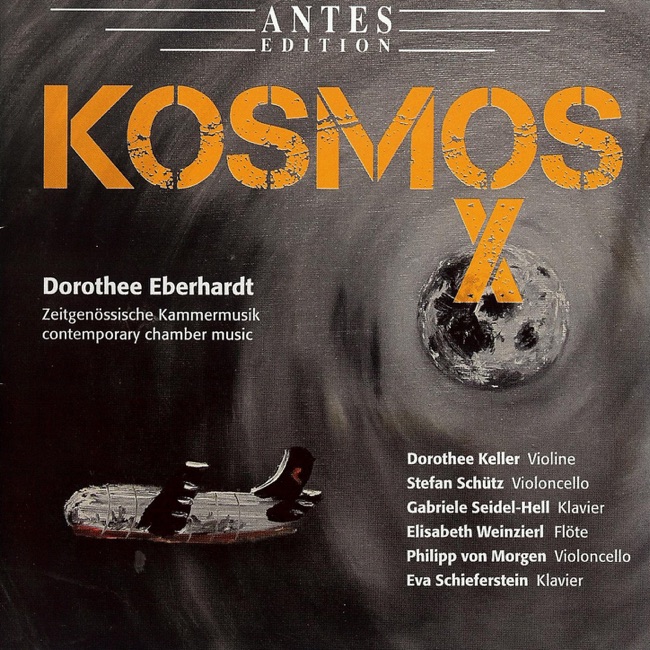
Dorothee Eberhardt
Released Album
Chamber
-
 September 21, 2018
 -
Artist Info
Role:ComposerDorothee Eberhardt was a German composer born on August 22, 1952, in Berlin. She grew up in a family of musicians, with her father being a pianist and her mother a singer. From a young age, Eberhardt showed a keen interest in music and began playing the piano at the age of five. She later went on to study music at the Hochschule für Musik Hanns Eisler in Berlin, where she received her diploma in composition. Eberhardt's early works were heavily influenced by the music of the Second Viennese School, particularly the works of Arnold Schoenberg and Anton Webern. Her compositions were characterized by their atonal and serialist structures, which were often complex and challenging for performers and audiences alike. Despite this, Eberhardt's music was well-received by critics and fellow composers, and she quickly gained a reputation as one of the most promising young composers of her generation. One of Eberhardt's early works, the String Quartet No. 1, was premiered in 1978 and received critical acclaim for its innovative use of serialist techniques. The piece was later performed by several renowned string quartets, including the Arditti Quartet and the Kronos Quartet. Eberhardt's other early works included the Piano Sonata No. 1 and the Chamber Symphony No. 1, both of which were similarly well-received. In the 1980s, Eberhardt's style began to evolve, as she began incorporating more tonal elements into her compositions. This shift was partly influenced by her growing interest in the music of the Romantic era, particularly the works of Gustav Mahler and Richard Strauss. Eberhardt's compositions from this period, such as the Symphony No. 1 and the Piano Concerto No. 1, were characterized by their lush harmonies and sweeping melodies, which were often reminiscent of the Romantic style. Despite this shift in style, Eberhardt's music continued to be marked by its complexity and technical virtuosity. Her compositions often featured intricate polyrhythms and unconventional time signatures, which required a high level of skill and precision from performers. This was particularly evident in her later works, such as the String Quartet No. 3 and the Symphony No. 3, which were both premiered in the 1990s. Eberhardt's music was performed by many of the world's leading orchestras and ensembles, including the Berlin Philharmonic, the New York Philharmonic, and the London Symphony Orchestra. She also received numerous awards and honors throughout her career, including the Ernst von Siemens Music Prize in 1998 and the Berlin Art Prize in 2002. Tragically, Eberhardt's career was cut short when she passed away on December 22, 2004, at the age of 52. Despite her relatively short career, Eberhardt left behind a significant body of work that continues to be performed and admired by musicians and audiences around the world. Her music remains a testament to her technical skill, artistic vision, and unwavering commitment to the art of composition.More....
Recent Artist Music
2
3:56
Copyright Ⓒ 2013 Davinci Finger. All rights reseved
Service Terms & Policy