


Hans Sandig
Artist Info
Role:Composer ConductorHans Sandig was a German composer born on January 12, 1921, in Berlin. He was the youngest of three children born to a family of musicians. His father was a violinist, and his mother was a pianist. From a young age, Sandig showed a keen interest in music and began playing the piano at the age of four. Sandig's parents recognized his talent and encouraged him to pursue a career in music. He began taking piano lessons with his mother and later studied composition with the renowned German composer Paul Hindemith. Sandig's early compositions were heavily influenced by Hindemith's neoclassical style, characterized by its use of counterpoint and strict adherence to form. In 1941, Sandig was drafted into the German army and served on the Eastern Front during World War II. He was captured by Soviet forces in 1944 and spent the remainder of the war as a prisoner of war. During his captivity, Sandig continued to compose music, using whatever materials he could find, including scraps of paper and pencils. After the war, Sandig returned to Berlin and resumed his studies with Hindemith. He also began working as a freelance composer, writing music for film, radio, and television. Sandig's early works from this period include a number of chamber music pieces, including a string quartet and a piano trio. In the 1950s, Sandig's music began to evolve, reflecting his growing interest in serialism and other avant-garde techniques. His compositions from this period include a number of experimental works, such as his "Three Pieces for Prepared Piano," which featured the use of various objects placed inside the piano to alter its sound. Sandig's most famous work, however, is his opera "The Trial," which premiered in 1963. Based on Franz Kafka's novel of the same name, the opera tells the story of a man who is arrested and put on trial for an unspecified crime. Sandig's music for the opera is characterized by its dissonant harmonies and angular melodies, which reflect the psychological tension of the story. In addition to his work as a composer, Sandig was also a respected music educator. He taught composition at the Berlin University of the Arts from 1960 until his retirement in 1986. Many of his students went on to become successful composers in their own right, including Wolfgang Rihm and Helmut Lachenmann. Sandig continued to compose music throughout his life, even after his retirement from teaching. His later works include a number of choral pieces, as well as several orchestral works, including his "Symphony No. 3," which premiered in 1992. Hans Sandig died on December 22, 1996, in Berlin, at the age of 75. He is remembered as one of the most important German composers of the 20th century, whose music reflected the changing cultural and political landscape of his time.More....
Recent Artist Music
2
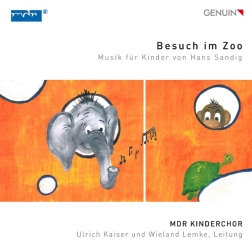
Visit to the Zoo - A cheerful animal song series
Kommt mit, wir fahren in den Zoo (Auftrittslied)
2:51
4

2:10
Copyright Ⓒ 2013 Davinci Finger. All rights reseved
Service Terms & Policy