


Johannes Schenck
Released Album
Chamber
-
 December 1, 2023
 -
 May 3, 2019
 -
 April 17, 2019
 -
 January 12, 2019
 -
 June 3, 2016
 -
 February 12, 2016
Opera
-
 March 27, 2007
Artist Info
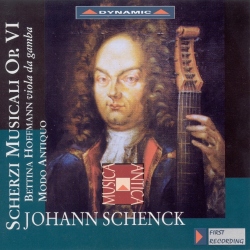
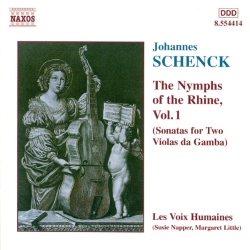
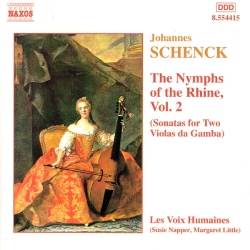
Role:ComposerCountry: NetherlandsBirth:June 3, 1660 in Amsterdam, The NetherlandsDeath:after 1712Period:BaroqueGenre:ChamberJohannes Schenck was a Dutch composer and musician who lived during the Baroque period. He was born in Amsterdam in 1660 and was the son of a German immigrant who was a member of the Amsterdam city band. Schenck grew up in a musical family and began his musical education at a young age. He learned to play the viola da gamba, a stringed instrument that was popular during the Baroque period. Schenck's musical talent was recognized early on, and he was soon performing in public. He became a member of the Amsterdam city band, where he played the viola da gamba and other instruments. He also performed in various ensembles and chamber groups, where he gained a reputation as a skilled musician. In addition to his performing career, Schenck was also a composer. He wrote music for the viola da gamba, as well as other instruments. His compositions were influenced by the French and Italian styles of the time, and he was known for his use of complex harmonies and rhythms. Schenck's most famous works are his sonatas for viola da gamba and basso continuo. These works were published in Amsterdam in 1699 and were well-received by audiences and critics alike. The sonatas are characterized by their virtuosic solo parts and intricate bass lines. They are considered some of the finest examples of Baroque chamber music. Schenck's sonatas were also notable for their use of the viola da gamba as a solo instrument. The viola da gamba was not a common solo instrument during the Baroque period, and Schenck's use of it helped to popularize the instrument. His sonatas were also influential in the development of the solo sonata form, which would become a popular genre in the Classical period. In addition to his sonatas, Schenck also wrote other works for the viola da gamba, including suites and fantasias. These works were also well-regarded and helped to establish Schenck as one of the leading composers of his time. Schenck's music was popular during his lifetime, and he was well-respected by his peers. He was a member of the prestigious Collegium Musicum in Amsterdam, which was a group of musicians who performed in public concerts. He also taught music to several students, including the composer and theorist Johann Mattheson. Despite his success, Schenck's life was not without its challenges. He suffered from financial difficulties throughout his career and was forced to sell his music manuscripts to make ends meet. He also experienced personal tragedy when his wife and children died in a fire in 1701. Despite these setbacks, Schenck continued to compose and perform throughout his life. He died in Amsterdam in 1712, leaving behind a legacy of innovative and influential music. His sonatas for viola da gamba remain some of the most important works of the Baroque period and continue to be performed and studied by musicians today.More....
Recent Artist Music
4
1:22
5
6:22
9
Sonata No. 6 in A minor (from L'Echo du Danube), Op. 9/6
2. Presto, Adagio, Aria Largo, Vivace, (Aria) Largo, Allegro, Largo, (Aria) Largo
8:15
11
3:36
12
2:17
14
2:23
Copyright Ⓒ 2013 Davinci Finger. All rights reseved
Service Terms & Policy